
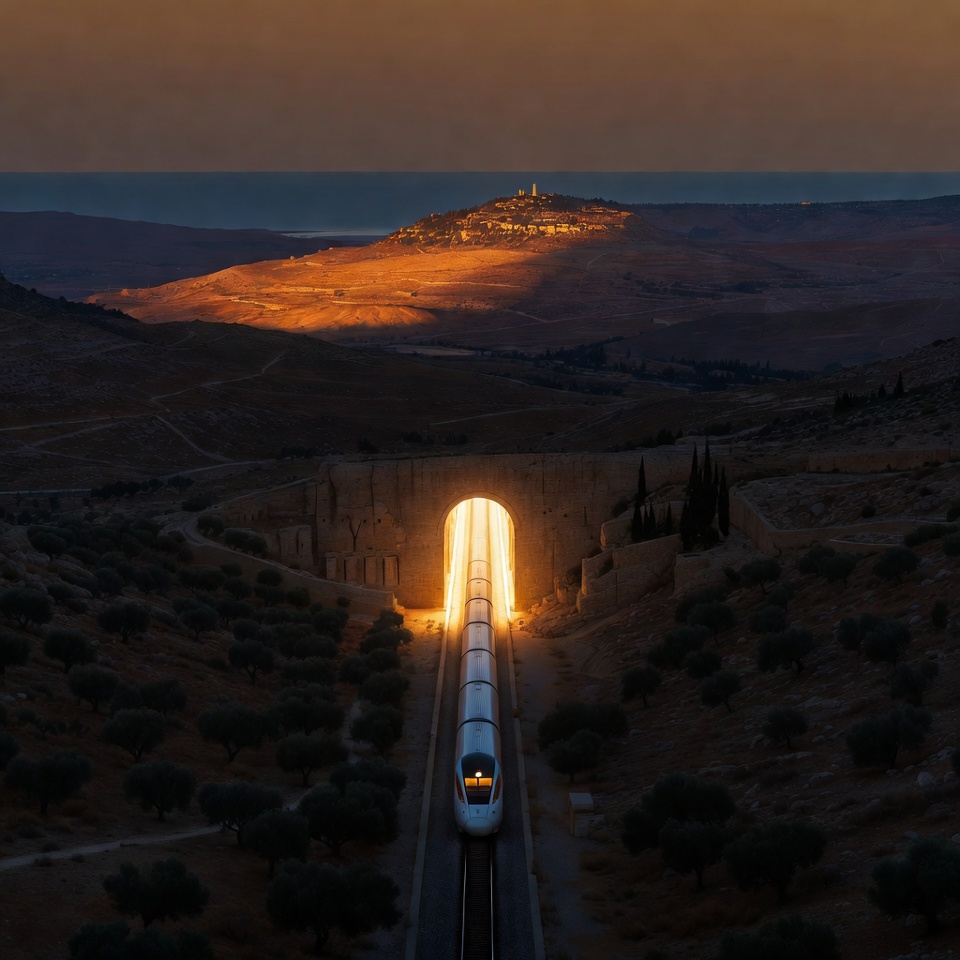
THE HOLY LAND EXPRESS
Connecting the Four Holy Cities of Israel
Jerusalem · Hebron · Tiberias · Tzfat
COMPREHENSIVE BUSINESS CASE & INVESTMENT PROPOSAL | APRIL 2026 | MORRIS LEGACY GROUP
1. Executive Summary
The Holy Land Express (HLE) is a proposed national high-speed rail network connecting Israel's four holy cities — Jerusalem, Hebron, Tiberias, and Tzfat — along with all major population centers between them. The long-term vision is a rail system that enables every Israeli citizen to reach each holy city for work, daily life, and the High Holy Days, without a car.
The network's first and primary corridor — Phase 1 — is the line between Jerusalem and Tiberias. This is where the Holy Land Express begins. Running 155 kilometres at 250 km/h, it reduces the Jerusalem–Tiberias journey from 2+ hours to approximately 50 minutes, and forms the backbone from which all future phases branch.
The Four Holy Cities
| Holy City | Significance | Current Rail | HLE Phase |
|---|---|---|---|
| Jerusalem — ירושלים | Western Wall, Temple Mount, Old City | Yes — Yitzhak Navon | Phase 1 terminus |
| Hebron — חברון | Mearat HaMachpelah; burial of Avraham, Yitzchak, Yaakov | None | Phase 4 (~30 km south) |
| Tiberias — טבריה | Rambam, Rabbi Akiva, Rabbi Meir Baal HaNes; Sanhedrin | None | Phase 1 northern terminus |
| Tzfat — צפת | Ari HaKadosh, Beit Yosef; centre of Kabbalah | None | Phase 2 (~30 km north) |
Phase 1 Key Metrics
| Metric | Value |
|---|---|
| Route | Jerusalem → Afula → Nazareth → Tiberias |
| Total Length | ~155 km |
| Design Speed | 250 km/h |
| Journey Time | ~50 minutes end-to-end |
| Tunnel Requirement | ~60 km (39% of route) |
| Total Capital Cost | ₪54–72B (USD $18–24B) |
| Security Overlay | +₪2.6–3.0B |
| 30-Year Lifecycle Cost | ~₪61.5–79.5B |
| Projected Ridership (Year 5) | 12–18 million passengers/year |
| Phase 1 Partial Opening | 2038 |
| Full Line (Jerusalem–Tiberias) | 2042 |
2. Project Overview & Vision
The Holy Land Express is named for a singular national purpose: to make the four holy cities of the Jewish people accessible to every Israeli citizen. These cities are the spiritual heartbeat of the Jewish people — home to the Patriarchs and Matriarchs, to the Sanhedrin, to the Rambam, to the Ari HaKadosh, to Rabbi Akiva, to the Beit Yosef.
Today, reaching any of these cities requires a car, a long bus journey, or a combination of disconnected rail lines. A grandmother in Beersheba cannot easily reach the Kever of Rabbi Meir Baal HaNes in Tiberias for his yahrzeit. A family in Tel Aviv cannot get to Tzfat for Lag BaOmer without a two-hour drive. A student in Haifa cannot commute to Jerusalem without losing half their day. The Holy Land Express changes this.
The Full Network (All Phases)
| Line | Route | Phase | Length |
|---|---|---|---|
| HLE-N | Jerusalem → West Bank tunnel → Afula → Nazareth → Tiberias | Phase 1 — this proposal | ~155 km |
| HLE-TZ | Tiberias → Rosh Pina → Tzfat | Phase 2 | ~30 km |
| HLE-JV | Tiberias → Beit She'an → Jordan Valley | Phase 3 | ~60 km |
| HLE-S | Jerusalem → Gush Etzion → Hebron | Phase 4 | ~30 km |
Phase 1 Route — Jerusalem to Tiberias
| # | Station | Elevation | km | Mode |
|---|---|---|---|---|
| 1 | Jerusalem — Yitzhak Navon | 760m ASL | 0 | Underground |
| — | West Bank tunnel (no stop) | Peak 880m | 90 | Tunnel |
| 2 | Afula / Jezreel Valley | 50m ASL | 110 | At-grade surface |
| 3 | Nazareth | 400m ASL | 120 | Tunnel portal |
| 4 | Tiberias | -200m (below sea level) | 155 | Viaduct / tunnel |
3. Technical Scope & Engineering
Segment Breakdown
| Segment | Length | Type | Key Challenge |
|---|---|---|---|
| Jerusalem exit + Judean/Samarian ridge | 33 km | Deep bored twin tunnel | 800–900m elevation, hard karst limestone |
| Ramallah–Nablus sub-section | 15 km | Tunnel + viaduct | Steep wadi crossings, West Bank jurisdiction |
| Nablus–Jenin descent | 20 km | Mixed surface + viaduct | Gradual descent, agricultural land acquisition |
| Jenin–Afula (Jezreel Valley) | 15 km | At-grade surface | Flat terrain, minimal engineering challenges |
| Afula–Nazareth ascent | 10 km | Bored tunnel | 350m climb, 3.5% max grade |
| Nazareth–Tiberias descent | 12 km | Tunnel + viaduct | 600m descent to -200m, Galilean escarpment |
| Total Tunnel | ~60 km | 39% underground | Unprecedented in Israeli rail history |
Infrastructure Specifications
| Track | Standard gauge (1,435mm), double track, fully electrified 25kV AC |
| Signalling | ETCS Level 2 (European Train Control System) |
| Design Speed | 250 km/h operational; 300 km/h design envelope |
| Rolling Stock | Siemens Velaro or Alstom Avelia (TBD); ~600 passengers per 8-car set |
| Peak Frequency | 4 trains/hour per direction |
| Safety | Cross-passage refuges every 250m, SCADA, fiber optic DAS throughout |
4. Security Architecture
The West Bank transit segment (~90 km) demands a multi-layered security architecture unprecedented in civilian rail, drawing on IDF tunnel detection doctrine, West Bank barrier technology, and international critical infrastructure standards.
Security Layers — Capital Investment
| Layer | Technology | Coverage | Capex (NIS) |
|---|---|---|---|
| Perimeter fence | Electronic sensor fence, patrol road, CCTV towers | 60 km (both sides) | ₪360M |
| Tunnel intrusion detection | Elbit Systems seismic/acoustic sensors | 60 km tunnel | ₪360M |
| Fiber optic DAS | Distributed Acoustic Sensing (vibration + heat) | Full 90 km WB segment | ₪135M |
| AI video surveillance | 5G cameras, PSIM integration, LiDAR | All portals + surface | ₪270M |
| IDF patrol roads | Hardened access road alongside surface track | 30 km | ₪270M |
| Hardened watchtowers | Every 2 km, remote weapon stations | 15 towers | ₪225M |
| Blast-rated tunnel portals | Reinforced concrete, biometric access control | 8 portals | ₪480M |
| Security Operations Centre | 24/7 SOC, IDF coordination, CCTV wall (Afula) | 1 facility | ₪450M |
| TOTAL SECURITY CAPEX | ₪2.55–3.0B | ||
Annual Security Operating Costs
| Item | Annual (NIS) |
|---|---|
| IDF dedicated battalion | ₪90–120M |
| Technology monitoring & maintenance | ₪60M |
| Shin Bet intelligence coordination | ₪30M |
| Emergency response | ₪45M |
| Total Annual Opex | ₪225–255M/year |
5. Cost Breakdown
Capital Expenditure by Work Package
| Work Package | Base Cost | Security | Total (NIS) |
|---|---|---|---|
| Jerusalem tunnels (exit + ridge) | ₪24–30B | ₪600M | ₪24.6–30.6B |
| Ramallah–Nablus tunnel/viaduct | ₪7.5–9B | ₪600M | ₪8.1–9.6B |
| Nablus–Jenin (mixed surface) | ₪4.5–6B | ₪600M | ₪5.1–6.6B |
| Jenin–Afula at-grade | ₪1.8–2.7B | ₪300M | ₪2.1–3.0B |
| Afula–Nazareth bored tunnel | ₪6–9B | ₪150M | ₪6.15–9.15B |
| Nazareth–Tiberias tunnel/viaduct | ₪7.5–10.5B | ₪150M | ₪7.65–10.65B |
| Stations (5 active + 2 WB caverns) | ₪1.5–3B | ₪300M | ₪1.8–3.3B |
| Rolling stock (20 trainsets) | ₪3–4.5B | — | ₪3–4.5B |
| Systems (signalling, comms, power) | ₪2.4–3.6B | — | ₪2.4–3.6B |
| PM & Contingency (15%) | ₪9–12B | — | ₪9–12B |
| TOTAL CAPEX | ₪67.7–90.3B | +₪2.7B | ₪54–72B central |
Central estimate: ₪63B (USD $21B) at 3.0 NIS/USD.
Phasing & Cost Schedule
| Phase | Period | Scope | Cost (NIS) |
|---|---|---|---|
| Phase 0 – Planning & EIS | 2026–2028 | Environmental study, geotechnical, diplomacy | ₪900M–1.5B |
| Phase 1A – Jerusalem TBM | 2028–2033 | Full tunnel bore, Navon → Jenin portal | ₪36–42B |
| Phase 1B – Jezreel + Nazareth | 2030–2035 | Afula station + Nazareth tunnel (parallel) | ₪9–12B |
| Phase 1C – Tiberias + systems | 2033–2038 | Final descent, all stations, systems integration | ₪12–15B |
| PHASE 1 OPENING | Q2 2038 — Jerusalem to Nazareth | Partial service | |
| Phase 2 – Full line to Tiberias | 2038–2042 | Complete Tiberias terminal, full service | ₪3–6B |
| Phase 3 – WB stops (conditional) | TBD post-2042 | Activate Ramallah + Nablus caverns | ₪1.5–3B |
6. Ridership Projections & Revenue Model
Ridership Forecast
| Year | Scenario | Passengers/year | Key Assumption |
|---|---|---|---|
| Year 1 (2038) | Conservative | 5M | Partial service only |
| Year 1 (2038) | Base | 7M | Strong tourism rebound |
| Year 5 (2043) | Conservative | 10M | Moderate modal shift |
| Year 5 (2043) | Base | 15M | Strong modal shift, peace dividend |
| Year 5 (2043) | Optimistic | 20M | WB stops open, tourism surge |
| Year 10 (2048) | Base | 22M | Network effects, Haifa HSR connected |
| Year 20 (2058) | Base | 30M | Full regional integration |
Revenue Streams (Year 5 Base)
| Stream | Assumption | Annual (NIS) |
|---|---|---|
| Domestic fares (₪270–450 avg) | 12M passengers | ₪1.5–2.1B |
| Tourist premium fares (₪600–1,050 avg) | 3M passengers | ₪450–750M |
| Station retail & advertising | 5 stations | ₪120–240M |
| Real estate / Transit-Oriented Dev. | Jerusalem, Afula, Tiberias | ₪300–600M |
| Government access fee | Per-train path charge | ₪240–360M |
| TOTAL ANNUAL REVENUE | ₪2.7–4.2B |
Financial Returns
| Annual Operating Cost (Year 5) | ~₪1.8–2.4B |
| EBITDA (Year 5 Base) | ~₪600M–1.8B |
| Operating Break-even | Year 8–12 post-opening |
| NPV (30-year, 6% discount) | ₪6–15B positive |
| IRR (with government capital grant) | 6–9% |
| Full Capex Payback | 25–35 years |
7. Stakeholder Engagement & Political Roadmap
Israeli Government — Primary Decision Makers
| Body | Key Decision | Engagement Strategy |
|---|---|---|
| Prime Minister's Office | Project authorization, security doctrine | Direct briefing; national legacy project framing; link to Galilee development agenda |
| Ministry of Transport | Budget allocation, route approval, operator selection | Align with national HSR masterplan; technical MOU with Israel Railways |
| Ministry of Finance | Capex approval; PPP framework | Full NPV model; comparator with Tel Aviv–Haifa HSR (₪12.6B for 70 km) |
| Ministry of Defence / IDF | Security doctrine; WB deployment | Classified briefing; present as strategic military corridor asset |
| Shin Bet (ISA) | Passenger screening; intelligence sharing | Classified briefing; joint security working group |
| National Planning Committee | Statutory route approval; EIS sign-off | Early engagement; environmental pre-application |
| Knesset Committees | Budget approval; PPP legislation | Parliamentary briefings; public hearings support |
Palestinian Authority
| Body | Key Ask | Approach |
|---|---|---|
| PA Presidency | Corridor agreement; future stop rights; revenue share | Back-channel via Jordanian/Egyptian intermediaries; offer future economic stake |
| PA Ministry of Transport | Safety standards; emergency access | Technical working group; joint tunnel inspection rights |
| PA Ministry of Finance | Transit royalty / fare revenue share | Structured revenue-sharing agreement for Phase 3 activation |
International Financiers
| Institution | Amount (NIS) | Instrument | Note |
|---|---|---|---|
| Israeli Treasury (equity grant) | ₪24–30B | Direct capital grant | 40% of total; non-repayable |
| EIB / AIIB (senior debt) | ₪12–15B | 30-year infrastructure loan | 3–4%; green transport framing |
| Private infrastructure funds | ₪12–15B | Equity + mezzanine in InfraCo | 20% stake |
| Israel Bonds (diaspora) | ₪6–9B | 30-year HLE-designated bonds | "Build the land" narrative |
| UAE / Bahrain SWFs | ₪3–6B | Strategic equity | Abraham Accords framing |
8. Governance & Procurement
Entity Structure
| HLEA | Holy Land Express Authority — Knesset statutory body; owns infrastructure; sets safety standards; security coordination |
| InfraCo | PPP project company; designs, builds, and maintains track/tunnels/stations; 30-year concession |
| OpCo | Rail operator; purchases track access; manages rolling stock, ticketing, customer operations (Israel Railways or private) |
| Security JV | IDF + Shin Bet + InfraCo joint venture; manages West Bank security infrastructure; MOD-funded |
| Advisory Board | Independent board: Israeli, Palestinian, EU, US, Gulf representatives — diplomatic legitimacy for WB segment |
Procurement Packages
| Package | Strategy | Key Contractors |
|---|---|---|
| WP1 – Jerusalem tunnels | Design-Build; international TBM tender | Vinci, Salini Impregilo, Acciona |
| WP2 – West Bank tunnel | Government-led; classified procurement | Israeli firms + international JV |
| WP3 – Jezreel surface | Design-Build; domestic + regional | Israeli contractors; max local content |
| WP4 – Nazareth–Tiberias | Design-Build; international tender | Complex geology specialists |
| WP5 – Systems (ETCS) | Systems integrator | Siemens, Alstom, Hitachi Rail |
| WP6 – Rolling stock | Competitive; technology transfer req'd | Siemens Velaro, Alstom Avelia, Hitachi Class 800 |
| WP7 – Security systems | Israeli defence industry preferred | Elbit Systems, Rafael, IAI |
9. Risk Register
| Risk | Category | Likelihood | Impact | Mitigation |
|---|---|---|---|---|
| WB political agreement fails | Geopolitical | High | Critical | Tunnel designed for autonomous operation; WB stops remain sealed until agreement |
| Security incident on WB segment | Security | Medium | Critical | Multi-layer IDF/ISA/technology defense; no surface exposure in WB |
| Ground conditions worse than forecast | Technical | Medium | High | 300+ boreholes before TBM procurement; 20% design contingency |
| Cost overrun (TLV–Jerusalem precedent) | Financial | High | High | Fixed-price DB contracts; independent cost reviewer; Knesset oversight |
| Construction delay (2038 target) | Schedule | High | Medium | Parallel WP1/WP3 construction; no critical path dependency between tunnel and surface |
| Ridership shortfall | Commercial | Medium | Medium | Conservative base case; government minimum revenue guarantee for first 10 years |
| Archaeological discovery | Regulatory | High | Medium | IAA embedded in project team from Phase 0; pre-tunnel survey mandatory |
| International opposition (ICJ/UN) | Legal/Political | High | Medium | 90% of route inside Israel proper; WB section underground; UN OCHA consultation |
| Rolling stock delay | Supply chain | Low | Medium | 7-year lead time; LOI to preferred supplier by 2029 |
| Financing / interest rate risk | Financial | Medium | Medium | Lock EIB/multilateral debt terms in Phase 0 |
10. Project Plan & Timeline
| Phase | Period | Milestone | Owner | Budget (NIS) |
|---|---|---|---|---|
| Phase 0.1 – Feasibility | 2026–2027 | Route confirmed; stakeholder MOU; PA back-channel opened | PMO + MFA | ₪150M |
| Phase 0.2 – EIS | 2026–2028 | Full environmental study published; IAA survey complete | HLEA + NPC | ₪300M |
| Phase 0.3 – Geotechnical | 2027–2028 | 300+ boreholes; karst mapping; aquifer study | InfraCo | ₪450M |
| Phase 0.4 – Finance Close | 2027–2029 | All tranches committed; PPP contracts signed | MOF + HLEA | ₪150M |
| Phase 1A – TBM Launch | 2028 | TBM assembled at Navon; boring commences | WP1 | ₪36–42B total |
| Phase 1A – Breakthrough | 2033 | 60 km tunnel complete; WB caverns sealed | WP1 | — |
| Phase 1B – Jezreel surface | 2030–2033 | Afula station + at-grade track (parallel to 1A) | WP3 | ₪2.1–3.0B |
| Phase 1C – Nazareth + Tiberias | 2033–2037 | All stations complete; systems installed | WP4 + WP5 | ₪15–18B |
| Phase 1D – Integration & testing | 2037–2038 | ETCS commissioning; safety case; trial running | WP5 + IR | ₪600M |
| PHASE 1 OPENING | Q2 2038 — Jerusalem to Nazareth | OpCo | 4 trains/hr peak | |
| Phase 2 – Full line | 2038–2042 | Jerusalem–Tiberias fully operational | WP4 | ₪3–6B |
| Phase 3 – WB stops | TBD post-2042 | Political trigger; Ramallah + Nablus fit-out | HLEA + PA | ₪1.5–3B |
11. ESG & Strategic National Value
Environmental Impact
- Modal shift: estimated 1.2–1.8M tonnes CO₂ reduction over 30 years
- Electrified traction: zero direct emissions in operation
- Full hydrogeological isolation of the Mountain Aquifer throughout tunnel bore
- Mandatory IAA archaeological survey and avoidance protocol before TBM launch
Social & Economic Impact
- 25,000–35,000 construction jobs; 2,000–3,000 permanent operational roles
- Expected 30–40% increase in day-trip tourism to Jerusalem and Tiberias
- Nazareth stop: first time Israel's largest Arab city connects to national HSR
- High Holy Days access: all Israelis reach the four holy cities by rail for Rosh Hashana, Yom Kippur, Sukkot, Pesach, and Shavuot
- Pre-wired WB stops: tangible, concrete peace incentive for Palestinian negotiators
Strategic & Diplomatic Value
- First tangible Abraham Accords infrastructure project with Gulf co-investment
- Positions Israel for TEN-T Mediterranean Corridor EU designation
- Most shovel-ready Israeli-Palestinian economic interdependence project available
- "Jerusalem to Tiberias in under an hour" — globally marketable tourism narrative
Appendix: The Boring Company — Featured Subcontractor
The Holy Land Express project team has identified The Boring Company (TBC), founded by Elon Musk, as a featured subcontractor candidate for select tunneling packages. TBC's speed-optimized TBM technology and appetite for unconventional engineering challenges make it a strong candidate for two specific segments.
Suitability by Segment
| Segment | Length | Suitability | Rationale |
|---|---|---|---|
| Jerusalem exit + Judean ridge | 33 km | LOW | Hard karst limestone; wrong diameter; unprecedented depth — needs Herrenknecht/Robbins |
| West Bank sub-tunnel | 27 km | LOW–MED | Security classification complicates US private contractor involvement |
| Afula–Nazareth ascent ✓ | 10 km | MED–HIGH | Shorter bore, manageable geology — best TBC candidate on the route |
| Nazareth–Tiberias descent ✓ | 12 km | MEDIUM | Spiral descent geometry plays to TBC's unconventional engineering strengths |
Timeline & Commercial Impact
- Potential time saving on Phase 2: 12–18 months — full line potentially opening 2040–2041 vs 2042
- Estimated contract value for WP5 + WP6: ₪2.5–3.5B
- TBC involvement generates significant international media — material benefit for investor roadshow
- Requires performance bonds, step-in rights, and conventional TBM fallback provisions
Engagement Roadmap
- 2026 Q3: Direct outreach from Israel — approach via Prime Minister’s Office tech liaison and existing Israeli GOI–Musk relationship; no embassy intermediary needed
- 2026 Q4: Technical NDA; share geotechnical data for WP5/6 segments
- 2027 Q1: TBC feasibility response; joint workshop with HLEA technical team
- 2027 Q3: Include TBC in WP5/6 Expression of Interest shortlist
- 2028: Formal subcontract award as part of WP5/6 Design-Build package
The Deeper Vision
Infrastructure is never just about getting from A to B. The Holy Land Express is a statement about what kind of country Israel wants to be — one where a secular family in Tel Aviv, a Haredi family in Bnei Brak, a Druze family in the Galilee, and an Arab family in Nazareth can all board the same train and arrive at the Kinneret together.
Where a lone traveler can daven at the Kotel in the morning and be at the Ari's mikveh in Tzfat by afternoon. Where every Israeli can reach the burial place of their ancestors, the seat of the Sanhedrin, the city of prophets, and the holy of holies — without a car, without a connection, without spending half their day on a highway.
The Sages teach that Yerushalayim is the spiritual center of the world, and the four holy cities are its coordinates. The Holy Land Express is an attempt to build physical infrastructure that honors that spiritual geography — and makes it real for every Israeli, every year, on every Yom Tov.
The full business case — technical scope, NIS cost breakdown, security architecture, stakeholder engagement, risk register, governance, and TBC subcontractor assessment — is available from Morris Legacy Group.