5787 – Chayei Sarah
Parashat Chayei Sarah 5787: a grave bought at full price in Hebron, a servant's prayer at a well, a woman who said I will go, and brothers at a grave.
Parashat Chayei Sarah 5787
A widower buys a grave in Hebron at full price before witnesses, sends his servant to find a wife for his son, and is buried by two sons who had not stood together since one was sent into the desert.
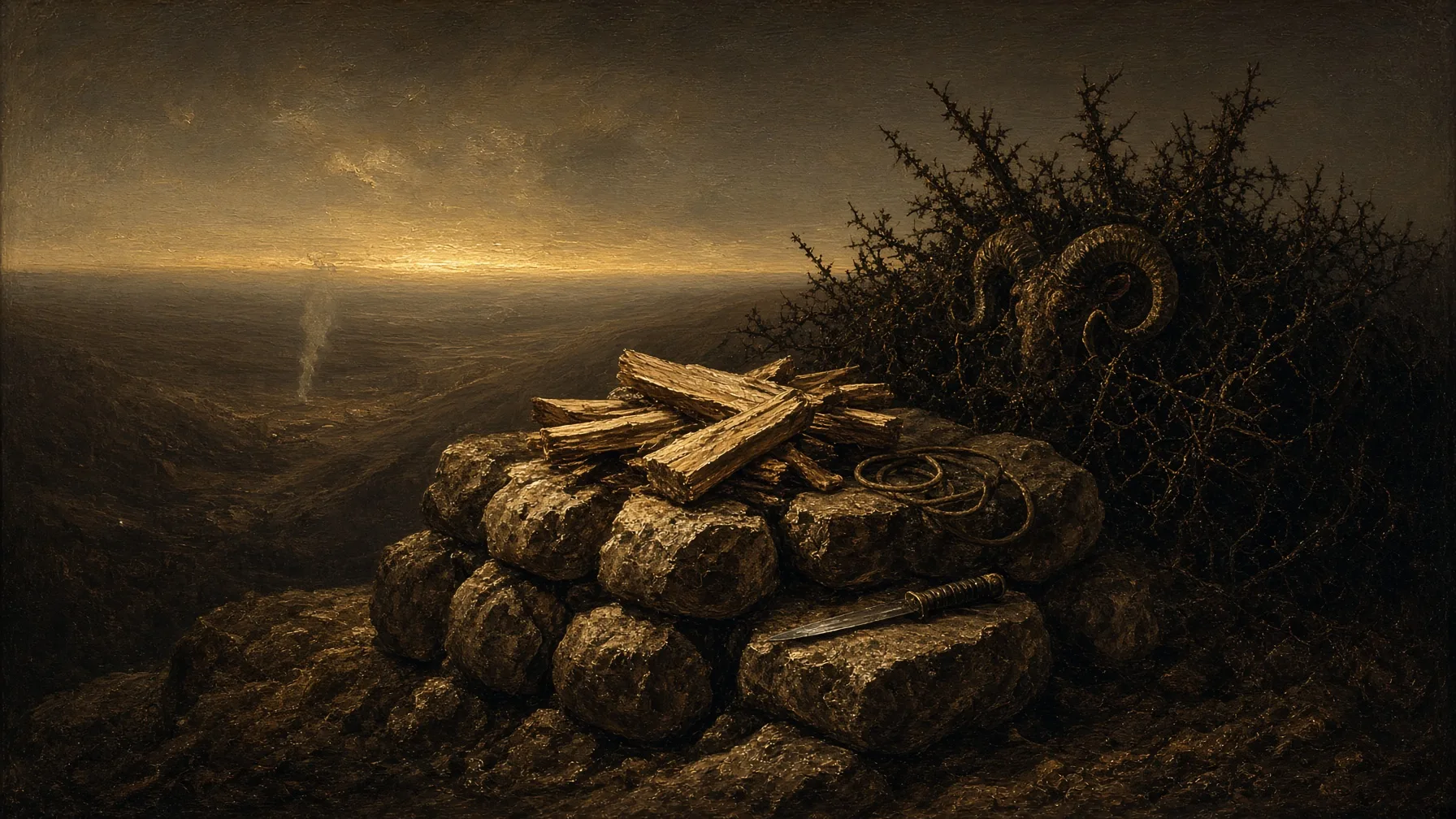
Last week ended on Mount Moriah, with the knife stayed and a ram in Yitzchak's place. This week opens with Sarah's death in Kiryat Arba, which is Hebron. Avraham comes to mourn and weep, rises from before his dead, and negotiates at the city gate for a grave: the Cave of Machpelah, bought from Ephron the Hittite for four hundred shekels of silver. He then sends his servant to Aram Naharayim under oath to find a wife for Yitzchak. At a well the servant prays for a sign, and Rivkah gives him water and draws for all ten of his camels. Her family asks her, will you go with this man? and she says I will go. Yitzchak is in the field at dusk when the camels come. Avraham marries again, gives all he has to Yitzchak, and dies at a hundred and seventy-five, and Yitzchak and Yishmael bury him together beside Sarah.
It is read this year eleven days after Israel voted, in a week of counting, consultations at the President's residence and talk of a Knesset with no clear majority, and in a week when Hebron, the city where the portion takes place, was in the news every day. A portion about mourning, buying land honestly, sending an emissary on a mission, kindness at a well and brothers at a grave sits beside all of that below. This post was written on Sunday 1 November.
Parasha at a Glance
| Name | Chayei Sarah, the life of Sarah. A portion named for her life that opens with her death. |
| Reading | Genesis 23:1 to 25:18, seven aliyot. Maftir Genesis 25:16 to 25:18. |
| Position | Fifth of the fifty-four parashiyot; the fifth portion of Sefer Bereshit. |
| Hebrew date | Shabbat, 27 Cheshvan 5787. Civil date 7 November 2026. |
| Haftarah | I Kings 1:1 to 1:31. King David is old, advanced in years, the same words used of Avraham, and Bathsheba and Natan secure the succession for Shlomo. |
| Shabbat Mevarchim | The new month of Kislev is blessed this Shabbat. Rosh Chodesh Kislev is Tuesday 10 November (30 Cheshvan) and Wednesday 11 November (1 Kislev). Hebcal gives the molad as Monday, 10:27 pm and 3 chalakim. |
| Israel this week | Sigd, the festival of Ethiopian Jewry and an Israeli national holiday, falls on Monday 9 November (29 Cheshvan). V'ten tal umatar continues in Israel from 7 Cheshvan; the diaspora waits until December. |
| Central theme | Mourning and its limit, an honest purchase in front of witnesses, the emissary who carries his master's mission, kindness beyond what is asked, consent, prayer at dusk, and brothers reunited at their father's grave. |
| Next parasha | Toldot, Shabbat 4 Kislev / 14 November 2026. |
Calendar, leyning and haftarah verified against the Hebcal Israel calendar with the diaspora setting off. This week Israel and the diaspora read the same portion and the same haftarah.
Torah Overview
The Cave, the Well, the Field, the Grave
The portion opens: Sarah's lifetime, the span of Sarah's life, came to one hundred and twenty-seven years. She dies in Kiryat Arba, which is Hebron, in the land of Canaan, and Avraham comes to mourn for Sarah and to weep for her. Then Avraham rose up from before his dead and spoke to the children of Heth: I am a resident alien among you; sell me a burial site among you. They answer that he is a prince of God among them and may bury in the choicest of their graves. Avraham bows to the people of the land and asks them to speak for him to Ephron, son of Tzochar, for the cave of Machpelah at the edge of his field, at the full price.
Ephron, sitting among his people at the gate, offers it as a gift: the field and the cave, I give it to you. Avraham insists on paying. Ephron names a figure as if it were nothing: a land worth four hundred shekels of silver, what is that between me and you? Avraham weighs out the silver in the hearing of the children of Heth, at the going merchants' rate. The Torah then records the transfer twice, field, cave and every tree within its borders, before all who went in at the gate of his city, and only between the two records does Avraham bury Sarah.
Avraham is old, and God has blessed him in all things. He makes his servant, the elder of his house, put his hand under his thigh and swear: not to take a wife for Yitzchak from the daughters of Canaan, and not to take Yitzchak back to the land Avraham left. If the woman will not come, the servant is released from his oath. The servant takes ten camels and goes to the city of Nachor. At evening, at the well where the women come to draw, he prays: let the young woman to whom I say, please lower your jar that I may drink, and who answers, drink, and I will also water your camels, be the one You have chosen. Before he has finished speaking Rivkah comes out with her jar on her shoulder. She gives him water and runs back and forth until the camels have finished drinking.
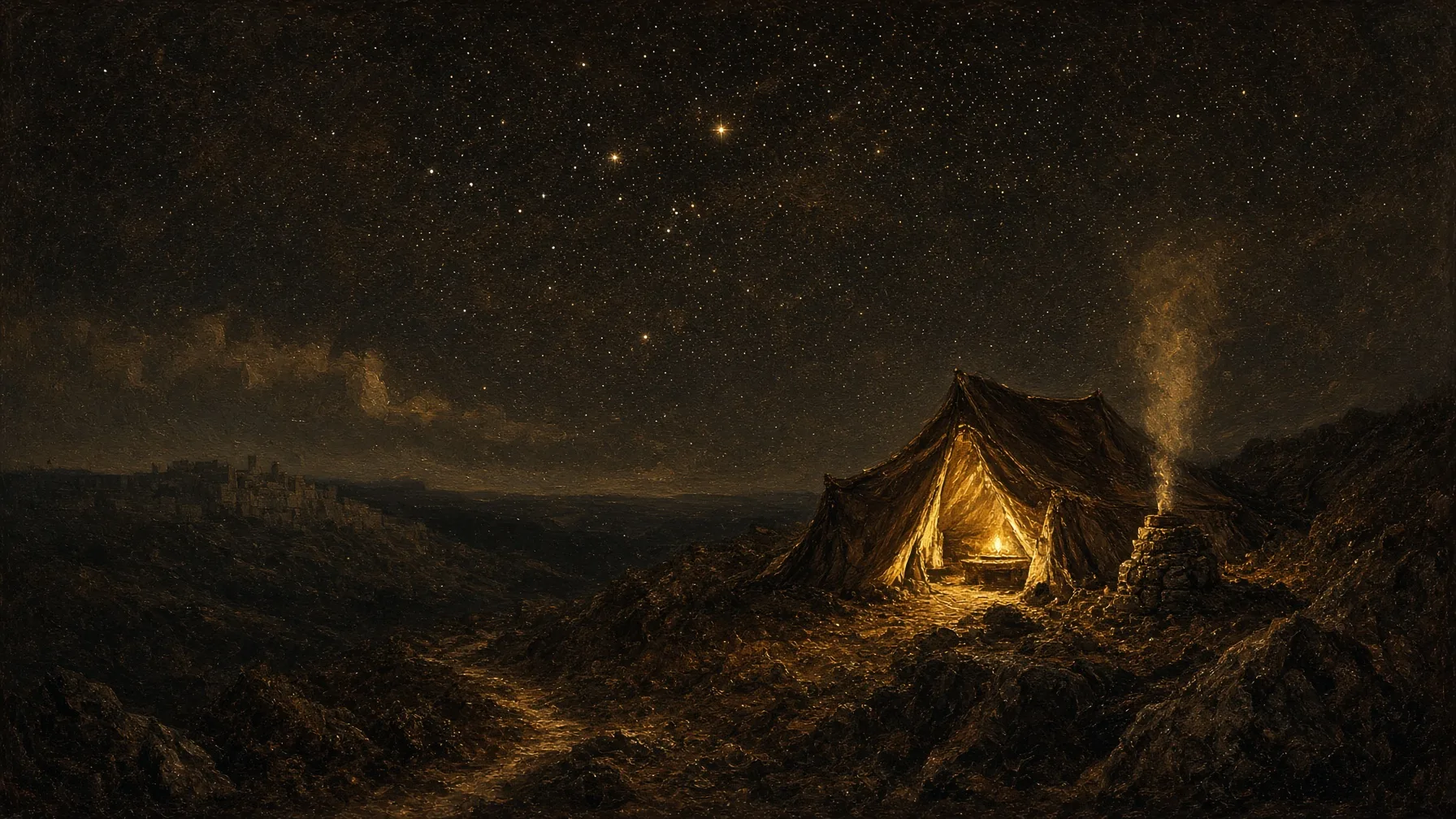
The servant tells the whole story again in Lavan and Betuel's house, refusing to eat until he has spoken. They answer that the thing has come from God. In the morning her brother and mother ask for a year, or ten months. The servant asks not to be delayed. They called Rivkah and said to her, will you go with this man? And she said, I will go. Yitzchak has gone out lasuach basadeh, to walk or to speak in the field, toward evening; he lifts his eyes and sees camels coming. Rivkah lifts her eyes, sees him, and covers herself with her veil. Yitzchak brings her into the tent of Sarah his mother, takes her as his wife, loves her, and is comforted after his mother.
Avraham takes another wife, Keturah, who bears him six sons. He gives all that he has to Yitzchak, gives gifts to the sons of the concubines, and sends them east while he is still alive. He dies at a good old age, old and satisfied, and is gathered to his people. His sons Yitzchak and Yishmael buried him in the cave of Machpelah, the field Avraham bought from the children of Heth. The portion closes with the twelve princes of Yishmael, by their villages and their encampments.
The haftarah, I Kings 1, opens with the words of the portion: King David was old, advanced in years. As Avraham secured Yitzchak's future before he died, David's last act is to secure Shlomo's, against Adoniyahu who has already declared himself king. The portion and the haftarah are both about an old man who settles the succession while he still can.
Talmudic Depth
A. The city of four couples: Eruvin 53a and Bava Batra 58a
Eruvin 53a records a dispute between Rav and Shmuel about the shape of the cave. One says it was two rooms, one farther in than the other; the other says it was a room with a second story above it. The second view explains the name Machpelah, double. For the first view, the Gemara answers that it is called double because it is doubled with the Patriarchs and Matriarchs, who are buried there in pairs. Rabbi Yitzchak adds that Hebron is called Kiryat Arba, the city of four, for the four couples buried there: Adam and Chavah, Avraham and Sarah, Yitzchak and Rivkah, Yaakov and Leah.
Bava Batra 58a tells of Rabbi Bena'ah, who marked burial caves so that kohanim and others would not become impure. At the cave of Avraham he found Eliezer, Avraham's servant, standing at the entrance. Asked what Avraham was doing, Eliezer said he was lying in Sarah's arms. Rabbi Bena'ah measured the cave and left. When he came to the inner cave of Adam, a heavenly voice told him: you gazed upon the likeness of My image; do not gaze upon My image itself. The servant who carried Avraham's mission in life, in the Gemara's story, still stands guard at his door.
B. Old age, and the blessing of everything: Bava Metzia 87a and Bava Batra 16b to 17a
Bava Metzia 87a reads Avraham was old, advanced in days as the first appearance of old age in the Torah. Until Abraham, there was no aging: people could not tell Avraham from Yitzchak. Avraham prayed for mercy, and old age became visible. What the world calls decline, the Gemara treats as something a tzaddik asked for, so that a father and son could be told apart and the elder honoured.
Bava Batra 16b lists answers to what God blessed Avraham bakol, with everything means. Rabbi Meir and Rabbi Yehuda dispute whether it means he had no daughter or that he did. Rabbi Elazar HaModa'i says the kings of East and West came to his door for his wisdom. Rabbi Shimon bar Yochai says a precious stone hung around his neck that healed the sick. Two more answers bear on this portion's ending: that Esav did not rebel while Avraham lived, and that Ishmael repented in Abraham's lifetime. The same daf teaches that on the day Avraham died Yaakov cooked lentils to comfort Yitzchak, because lentils were the food of mourners. Bava Batra 17a counts Avraham among the three who were given a taste of the World to Come in this world, from that same word, bakol.
C. The servant who drew from his master's well: Yoma 28b
Yoma 28b reads the servant's title, the elder of his house, who ruled over all that he had, as a statement about Torah. Rabbi Elazar says he had mastery over the Torah of his master, and reads his earlier name, Dammesek Eliezer, as doleh umashkeh: he drew from his master's Torah and gave others to drink. The same passage says the patriarchs and Eliezer each sat in yeshiva, and that from the days of the fathers a house of study never left Israel.
The image fits the portion exactly. The man defined in the Gemara as one who draws water and gives others to drink is sent to a well, and he chooses the woman who does the same thing unasked.
D. A prayer asked carelessly, and a road made short: Taanit 4a and Sanhedrin 95a
Taanit 4a brings Rabbi Shmuel bar Nachmani in the name of Rabbi Yonatan: three people asked improperly, and two were answered properly. The first is Eliezer at the well. His sign allowed for any woman who offered water, even lame or even blind, and he had already committed to bringing her to Yitzchak. Nevertheless, God responded to him reasonably, and Rivkah came out. The Gemara's lesson is not that the sign was wrong, but that an honest messenger who speaks loosely can still be answered with more than he deserved.
Sanhedrin 95a brings a baraita that the land contracted, kefitzat haderech, for three people: Eliezer, Yaakov, and Avishai son of Tzeruyah. For Eliezer the proof is his own words, I came today to the well: he left Canaan and arrived on the same day. The road is shortened for the one whose mission is not his own.
E. A conversation in the field: Berakhot 26b
Berakhot 26b, in the baraita that Avraham instituted the morning prayer, continues: Isaac instituted the afternoon prayer, as it is stated: And Isaac went out to converse in the field toward evening, and conversation means nothing other than prayer, from a prayer of the afflicted when he is faint and pours out his complaint, sicho, before God. Yitzchak's prayer is the one said in the middle of the working day, in the open, alone, while the light is going.
The JPS translation on Sefaria notes that the meaning of lasuach is uncertain; the Gemara's reading is a reading. But it is the reading on which the whole of Jewish practice rests: Minchah is said in the late afternoon because Yitzchak was in a field then. He had buried his mother and not yet met his wife, and what he did with that hour was speak to God.
Kabbalistic Depth
A. Zohar: The days of the righteous remain
On the opening verse, Zohar Chayei Sara 5:23 to 5:25 brings Rabbi Shimon on why year is singular with the hundred and the twenty and plural with the seven. The hundred and the twenty belong to the higher realms, which are one; the seven correspond to the seven lower realms, which divide into justice and mercy. But they are all called life. At 5:26 Rabbi Chiya says the word vayihyu, and they were, has the numerical value of thirty-seven: the years from Yitzchak's birth to the Akeidah, after which Sarah died, were the real life of Sarah.
Zohar 7:35 to 7:36 sets this against the ordinary measure of a life. A man's days, the Zohar says, are created in the supernal grades, and when they run out they have nowhere left to abide. Not so the days of the righteous. They have a permanent abiding. The Zohar adds that the Torah also counts the years of the life of Yishmael, and explains it the same way: Yishmael repented, and his days too became permanent. The Zohar and Bava Batra 16b, above, agree on this point from different directions.
B. Zohar: The light in the cave, and Adam's smile
Zohar 14:88 to 14:89 brings Rabbi Yehuda: Avraham had already been inside the cave. He saw the form of a man, and while he was gazing a door opened into the Garden of Eden, and he saw the same form standing at it. Whoever looks at the form of Adam cannot escape death, yet Avraham looked and lived, and saw a shining light and a burning lamp, and set his heart on the cave from that day.
Zohar 15:105 to 15:110 continues. When Avraham first entered, Adam rose, saw him and smiled; he had lain hidden like a corn seed in the ground until Avraham came. When Avraham brought Sarah to be buried, Rabbi Shimon says, Adam and Chavah rose and refused her: is not our shame already great enough, that you come to shame us further with your good deeds? Avraham answered that he would make atonement for them, so that they would not be shamed again. Only then did he bury Sarah, and he placed Chavah back beside Adam. The first couple, who brought death into the world, are given their rest through the man who came to bury his wife.
C. Zohar: Darkness for the seller, the whole land folded beneath
Zohar 14:90 to 14:93 admires Avraham's tact. He did not ask first for the cave, and did not speak first to Ephron; he asked the people for a burial place with you, so that no one would think he meant to set himself apart. In the midst of you I desire to be buried, for as I am fond of you I do not wish to keep aloof from you.
Zohar 15:103 to 15:104 says that Ephron saw only darkness in the cave, and that had he seen what Avraham saw he would never have sold it. That is why, the Zohar says, he sold more than was asked: field, cave and trees. At 15:111 to 15:113 Rabbi Elazar asks why the field, and not only the cave, is called Machpelah. Rabbi Shimon answers that the whole Land of Israel and Jerusalem is folded up beneath it, as there is a Jerusalem above and below. The Zohar is speaking of what is hidden in a place and who is able to see it. It is a teaching about spiritual perception, not a title deed in any modern dispute, and the World This Week below does not use it as one.
D. Zohar: Minchah at the well and in the field
Zohar 20:218 brings Rabbi Yose: the merit of Avraham stood by his servant, so that he reached the well on the day he set out, the Zohar's version of the shortened road in Sanhedrin 95a. Zohar 22:226 adds that the servant met Rivkah at the time of evening, the hour of Minchah, at the same moment Yitzchak was beginning his afternoon prayer, and that Rivkah came to Yitzchak himself at the time of his Minchah.
Zohar 23:238 to 23:240 explains the hour. Avraham's morning prayer belongs to the time of chesed, while the sun is in the east. When it turns west, the shadows of the evening are stretched out, and the grade of rigour asserts itself, the hour, the Zohar says, when the Temple was destroyed. For this reason tradition teaches us that a man should be careful not to miss the afternoon prayer, as then is the time when the world is under the aegis of rigour. Yitzchak prays in the hour of judgment, and that is the hour his answer comes over the horizon.
E. Zohar and Chassidut: Sarah's image in the tent, all her years alike, and the channels of blessing
Zohar 24:250 brings Rabbi Elazar on Yitzchak brought her into the tent, Sarah his mother: although Sarah died, her image did not depart from the house. It was hidden until Rivkah came, and then it was seen again, and only Yitzchak saw it; that is how Yitzchak was comforted after his mother. Zohar 25:259 to 25:260 adds that Avraham never entered Sarah's tent again, and left it to Yitzchak, and reads Avraham gave all that he had to Yitzchak as the form of Sarah that dwelt there.
The Sefat Emet, Chayei Sara 1:5, takes Rashi's comment that Sarah's years were all equally good. An ordinary person improves with age by discarding what he did when young, so only his last stretch is truly his life. Sarah rose higher in old age, but it was not by way of pushing off the earlier actions from the days of her youth. Each day was its own repair, not a correction of a day before. The Me'or Einayim of Rabbi Menachem Nachum of Chernobyl, a disciple of the Baal Shem Tov and the Maggid of Mezeritch, reads God blessed Avraham bakol with the midrash that it came by the merit of tithing (Chayei Sara 15 to 16): blessing flows down channels that a person's own corruption blocks, and giving sweetens the judgments until they consent to let the blessing through. In the measure with which a man measures, so is he measured.
This section does not quote the Arizal, the Alter Rebbe, the Baal Shem Tov directly, Rebbe Nachman or the Pri Tzaddik, because no passage of theirs on this portion could be checked against an English text on Sefaria or Chabad this week. Their teaching is not invented here. For further listening, Chabad's Chayei Sarah audio classes include Mendel Kaplan's Kabbalah on the Bible: Chayei Sarah and Berel Bell's The Chassidic Dimension: Chayei Sarah. On the double record of the purchase and why the Torah dwells on it, see Rav Gad Eldad of Yeshivat Har Etzion, The Purchase of Me'arat Ha-Machpela, which sets the Ibn Ezra and the Ramban against each other on exactly that question.
The World This Week
Seven structural parallels from the news of 25 October to 1 November 2026. Each is a comparison of shape, not of persons. No one in the news is Avraham, Sarah, Eliezer, Rivkah, Yitzchak or Yishmael, and no one is Ephron. Figures are given as the source that asserted them gave them. The sources in this section are news reports, not Torah sources.
1. Avraham came to mourn for Sarah, and to weep for her
Sgt. Yuval Shai Svilem, 20, was buried in Hod Hasharon on 25 October, with hundreds attending according to Hebrew media; Staff Sgt. Ron Yonatan Roytman, 23, was buried earlier the same day at the military cemetery in Ashkelon. Both were killed in the shooting attack near Hebron two days earlier. The Times of Israel, citing Israel National News, quoted Svilem's sister Shira: You will be etched in my heart forever, and I won't give terrorists the joy of breaking my spirit (Times of Israel, 25 October).
The shape is the opening of the portion: a death in Hebron, and a family that mourns and weeps. The correction is that these two young men were murdered, and Sarah died at a full age; their families have not been given a life complete in all its years. What the Torah gives them is the next verse. Avraham rose up from before his dead: mourning is commanded, and it is also given a limit, so that the living can stand again. A sister who says the terrorists will not break her spirit is doing what the verse describes. And the Gemara's lentils, the round food set before mourners, belong to every house that sits shiva this week.
2. I am a resident alien among you
The IDF operation in Hebron that followed the attack continued through the week. Ynet reported on 26 October that Chief of Staff Eyal Zamir argued the time had come to end the operation, and that Prime Minister Netanyahu and Defense Minister Katz rejected this; the 98th Division was carrying out searches, arrests, evacuations of residents and demolitions, and military officials raised legal concerns about keeping residents from their homes for long periods (Ynet, 26 October). The Palestinian Authority prime minister's office, citing Hebron Municipality data, said more than 2,670 Palestinians have been forcibly displaced from the Ein Deir Baha neighbourhood (Asharq Al-Awsat, AFP, 26 October). The Jerusalem Post reported Central Command officers saying hundreds of families were evacuated and hundreds of structures searched without weapons found, and security officials saying the operation uncovered a substantial Hamas network (Jerusalem Post, 27 October). These accounts are given as each source gave them and are not reconciled.
The shape is Avraham at the gate of Hebron: a man with a promise from God who nevertheless buys, pays the full price, weighs the silver in public and has the transfer recorded twice before witnesses, and who, the Zohar says, asked to be buried in the midst of you and not apart. The correction runs in every direction at once. The murderers are murderers, and a state must stop those who sent them. The families moved out of their homes are not the children of Heth and not Ephron; they are people. And the Torah's first transaction in the Land is a lesson in doing right in plain sight, before every party, so that no one can later say it was taken. This page makes no ruling on the operation.
3. The servant who was sent under oath
With all votes counted, the Times of Israel reported Prime Minister Netanyahu's bloc at 53 seats, Gadi Eisenkot's bloc at 48 and the Arab-led parties at 19, with Likud at 27, Yashar 21 and B'Yachad 12; turnout was 77.9 percent of 5,716,665 votes, and the acting director of the Central Elections Committee called fraud reports entirely unfounded (Times of Israel, 30 October). President Herzog asked the factions to come to consultations with an open mind and pledged absolutely everything in my power to prevent repeat elections (Ynet, 28 October). Eisenkot set out conditions for joining his government, among them the values of the Declaration of Independence, compulsory national service and recognising Hamas as a terror group, and said the door to the government we will establish is open to every elected official who accepts these principles (Times of Israel, 31 October).
The shape is the servant's mission: a man sent to find a partner, bound by an oath with conditions, told what he may not do and released if the other side will not come. The correction must be explicit. No politician is Eliezer, no coalition is a match made in heaven, and the President is not Avraham. What the Gemara admires in Eliezer is that he carried someone else's mission and not his own, that he told the whole truth in Lavan's house before he ate, and that he refused to be delayed. That is a standard for any emissary, of any bloc. This page endorses no list. More on how Torah frames leadership in Israel is in The Leadership of Israel.
4. Drink, and I will water your camels too
Ynet profiled Haverim Mehalzim, Friends Rescuing Friends, a volunteer network founded in 2023 by Nirit Rimon after her son Yanai drowned in Mexico, which searches for Israelis lost abroad at no cost to their families. About 33 volunteers searched Mount Olympus for Ami Yogev, 46, of Modi'in, and found his body on 9 October. The article puts the network in 49 countries with more than 1,000 requests, of which just over 230 were real emergencies; co-CEO Ron Lavi estimates about 35 people would likely not be alive without it. Asked why so many Israelis came to search for one man, Lavi said: No. He's just an Israeli (Ynet, 29 October).
The shape is the well: a stranger asks for a little water, and the answer is more than he asked, given running, until every camel has finished drinking. The correction is that these volunteers are not being tested by anyone, and kindness is not a sign to be read for some other purpose. Eliezer used Rivkah's kindness as a sign; Taanit 4a says even that was asked loosely. A mother who turned her son's death into a search for other people's sons needs no sign. The Gemara called Eliezer the one who draws water and gives others to drink. So are they.
5. Will you go with this man? I will go
VINnews reported on 26 October that 781 charedi men had joined military programmes since August, 286 of them in combat roles against 230 a year earlier, which it called a record; it gave the IDF target as 4,800 a year (VINnews, 26 October; the report does not link an IDF release). The same day the Jerusalem Post reported tens of thousands at a UTJ rally in Bnei Brak, cited an Israel Democracy Institute survey in which 72 percent of Jewish respondents support requiring young charedi men to enlist, and quoted a yeshiva student: If my rabbi says to leave (the country), I'm going to leave (Jerusalem Post, 26 October).
The shape is the morning in Lavan's house. The family wants to delay; the emissary wants to leave; and in the end let us call the young woman and ask her. The decision is hers, and she answers in one word. The correction is that neither the army nor the yeshiva is Lavan, and neither is Avraham's house. The Torah does not tell this page how the draft law should be written. What it does insist on is that the person being sent is asked, and that the answer is his own, whether it is given to a rabbi, a recruiting office or his own conscience. The question the Torah asks Rivkah is put to each of them, and each answer belongs to the one who gives it.
6. Yitzchak went out to speak in the field toward evening
Ahead of the vote, the rabbinic organisation Tzohar published a prayer for voters asking them to accept the result and respect those who vote differently. Rabbi David Stav: Election Day is not simply a day where we choose our political leaders, and we must never forget that the day after the elections, we will continue to live here together (Israel National News, 26 October). On the eve of the vote Prime Minister Netanyahu visited the Western Wall and prayed, JNS reported, for victory of the people of Israel (JNS, 27 October).
The shape is Minchah: prayer in the hour when the light turns and, the Zohar says, judgment is in the world. The correction is that the field is not a stage. Yitzchak prayed alone, with no one watching, and the Gemara learns the afternoon prayer from him for exactly that reason. Prayer by any candidate is between that person and God and is not a campaign event in the Torah's eyes, whoever's it is. The Tzohar prayer asks for the thing that Yitzchak's field teaches: that what comes over the horizon after the vote is received, and lived with, together.
7. His sons Yitzchak and Yishmael buried him
Yoav Segalovitz, 67, a Jewish former police investigator, enters the Knesset for Mansour Abbas's Ra'am, which won eight seats; he told AP: He's Arab. I'm a Jew. I'm secular. He's religious, and we can't just ignore 21% of the population. Abbas said hundreds of thousands of Arab and Jewish citizens went against the tide (Times of Israel, AP, 31 October). Arab News reported a record 19 seats for Arab-led parties; Joint List leader Yousef Jabareen said we do not see the possibility of being part of an Israeli government coalition under the current political circumstances; and Qatar called the claim from Netanyahu's bloc that Qatari money drove Arab turnout ridiculous and dangerous (Arab News, 30 October).
The shape is the end of the portion: two sons of one father, separated since one was sent away, standing together at his grave. The correction is essential. Arab citizens of Israel are citizens, not a figure in a verse, and Jewish citizens are not Yitzchak by virtue of a ballot. No party is either brother. The parallel is the act and nothing more: people who did not expect to stand side by side doing so at a moment that mattered. The Torah's interest is in the burial, in what the two sons did together, and not in anyone's arithmetic. This page endorses no list and no coalition.
Summary
| Torah | Sarah dies in Hebron; Avraham mourns, rises, and buys the Cave of Machpelah at full price before witnesses; his servant swears, travels, prays at a well and finds Rivkah; she says I will go; Yitzchak prays in the field and is comforted in his mother's tent; Avraham dies and is buried by Yitzchak and Yishmael. |
| Talmud | The city of four couples and the double cave (Eruvin 53a, Bava Batra 58a); old age as a prayer answered, and the blessing of everything (Bava Metzia 87a, Bava Batra 16b to 17a); the servant who drew from his master's Torah (Yoma 28b); a sign asked loosely and a road made short (Taanit 4a, Sanhedrin 95a); Minchah from the field (Berakhot 26b). |
| Kabbalah | The days of the righteous remain; the light in the cave and Adam's smile; darkness for the seller and the land folded beneath; Minchah in the hour of rigour; Sarah's image in the tent, all her years alike, and giving that opens the channels. |
| This week | Two soldiers buried after the Hebron attack; the Hebron operation, and accounts of it that differ; the final count and the President's consultations; volunteers who search for the lost; enlistment and a rally in Bnei Brak; prayers before the vote; a Jewish member of an Arab-led party. |
| The thread | Avraham's last chapter is about doing the lasting things properly: a grave bought honestly, a mission given to a faithful messenger, a decision left to the one who must make it, and a family that came together again at the end. |
Closing
May the families who buried their sons this week rise from before their dead and be comforted, as Yitzchak was comforted. May everything done in Hebron be done in plain sight, at full measure, before every witness. May every emissary carry the mission he was given and not his own. May the kindness of the well, given running and unasked, never run dry in Israel. May the young who are asked answer freely. May the prayer of the field at dusk be heard in the hour of judgment. And may the children of Avraham stand together, as his two sons stood together at Machpelah, under the blessing of bakol, everything.
Shabbat Shalom.